


Countries | Denmark and Sweden
Sweden
In late 1893, Melba headed to Scandinavia for a short tour before crossing the Atlantic to launch her American debut season.
The tour from October 31 to November 15 included Sweden and Denmark where Melba was met with ‘instantaneous appreciation’.
On October 31, 1893 Melba sang in Romeo and Juliet at the Opera House in Stockholm. Other operas were Lohengrin and Faust. For concerts Melba performed the Mad Scene from Hamlet and the Mad Scene from Lucia di Lammermoor. (1)
Writing of her role as Elsa in Lohengrin, the critic from the Swedish newspaper Dagen Nyheter wrote:
“Melba is Elsa .. Everyone who sees her in Elsa is soon convinced that the famous singer is also a great actress”
In the scene outside the church, the critic wrote:
“Madame Melba acted with such alert and subtle understanding, such admirably considered detail, that her impersonation would have honoured even an actress of rank who relied solely on her dramatic portrayal for her place in public esteem.” (2)
Towards the end of the season in Stockholm, Oscar, the King of Sweden and Norway sent Melba a note asking if she could await his return to the capital so he could hear her sing.
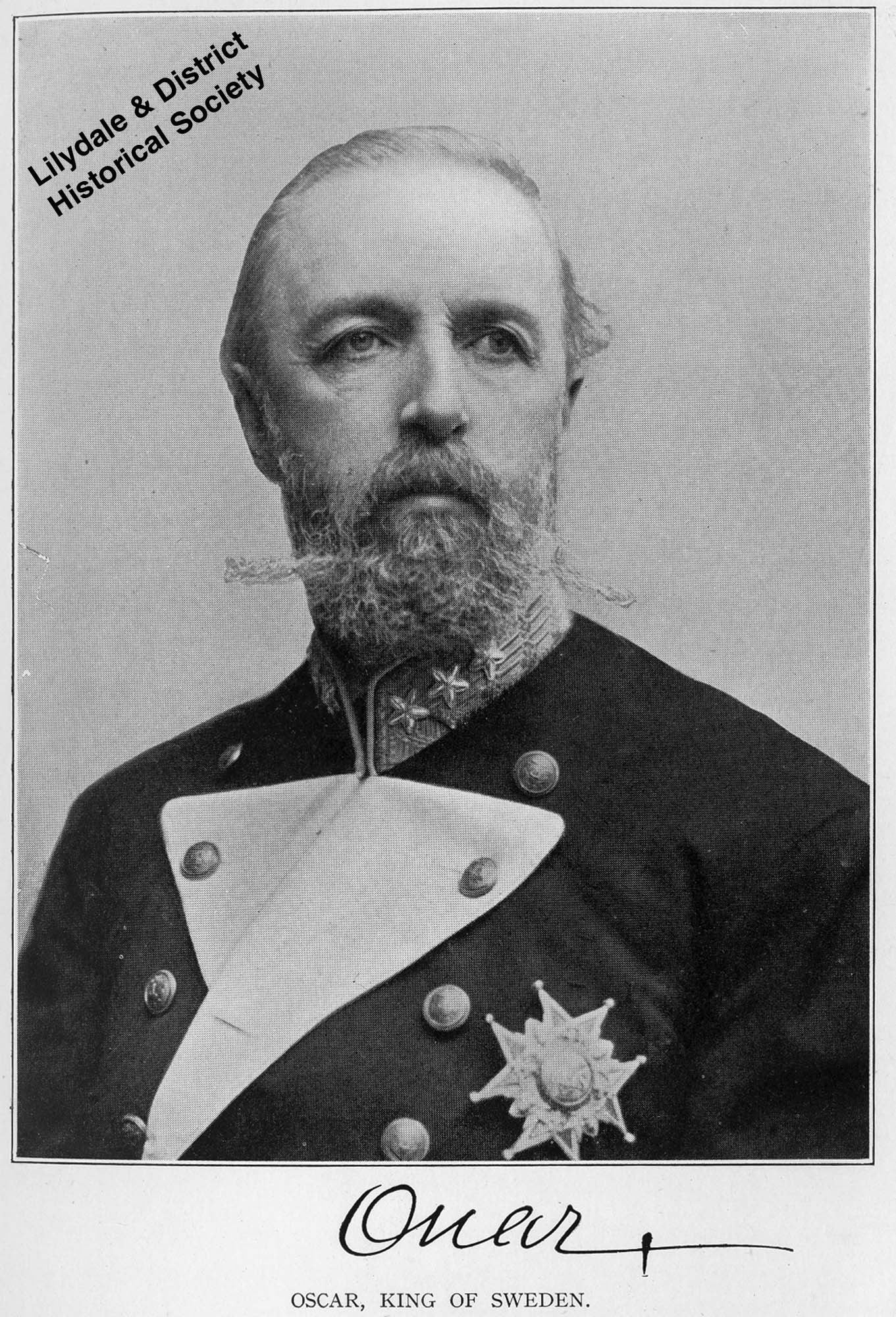
YMelba had little time left before she had to go to America but cabled the promoter Maurice Grau who gave her an extra week.
The King selected the program which Melba said was ‘as arduous a selection as any singer could possible undertake’:
1. The Balcony scene from Romeo.
2. The second Act of Lohengrin.
3. The Third Act of Lucia.
4. The Fourth Act of Faust. (3)
Twice during the program the King stood and bowed to Melba from the royal box.
During the performance he sent a message he wanted to meet Melba at the palace the next day.
Melba described that meeting:
I arrived ten minutes before the time and was ushered through endless suites of the exquisitely decorated drawing-rooms until eventually I arrived at a small room, furnished in the simplest possible style. Here I found the King waiting for me, with a single groom-in-waiting by his side. He greeted me in Italian, and for some time we talked in this language, until suddenly, finding I could not express myself freely, I said: ‘Perhaps Your Majesty does not know that I am Australian.’
The King: ‘Are you really? That’s splendid. Then we’ll talk Australian. But, before we say anything else, I want to confer this decoration on you.’
It was the decoration ‘Litteris et Artibus’ and I expressed my appreciation and honour with such sincerity that I made him laugh.
‘But won’t you pin it on for me, Sir?’
The King : ‘Of course I will. Lend me a pin.’
Myself: ‘I’m afraid I only have a hat pin.’
The King : Fancy a woman without a pin!’
The gentleman -in- waiting supplied one, and His Majesty pinned it on my breast, where it has often reposed since.
The King: ‘But one ought never to give people pins. It’s supposed to bring ill-feeling. I shall have to take your decoration off again.’
Myself : ‘Oh, Sir, please don’t do that.’
The King: ‘Very well, then. I know a way of making that all right.’
And he kissed me on both cheeks, explaining that, by doing so, he was taking away any evil spell. After that he took me to see the Crown Prince – the present King – and came down to put me into my carriage.
I left Stockholm a proud woman, not only because of the King’s graciousness but also because, when I arrived at the station, I found a crowd of five thousand people to see me off, all singing their divine Swedish folk tunes. (page 81).
It was one of those tunes which Christine Nilsson introduced as a solo in Hamlet. (4)
When Melba left for the station, she found 5000 people were there to see her off and all were singing ‘divine Swedish folk tunes, one of which Christine Nillson introduced as a solo in Hamlet.’ (5)
It was another three years – 1896 – before Melba met the King again when he visited her at her Paris apartment for a cup of tea and they spent afternoon singing duets from about half a dozen operas.
It was three years before I was again to have the honour of seeing the King of Norway and Sweden, and this time it was in the most unorthodox way. I was sitting one afternoon in my flat in Paris when my butler rushed in, very agitated, crying:
‘Madame – Madame – there is a lunatic at the front door.’ I prepared to fly, when he added: ‘An enormous man, of height incredible. He demands to see you, and he pretends he is the King of Sweden!’
I gasped with relief and anxiety, for a while I was glad to escape from the mythical lunatic, I was not at all sure how the King would like the reception which my butler appeared to have given him. However, when he entered, his face was wreathed with smiles, and he greeted me with all his old cordiality.
‘I’ve come to have a cup of tea with you,’ he said; ‘I’m absolutely dying for a cup of tea.’
After tea, he sprang to his feet, saying ‘Now let’s sing.’ And he went to the piano and dragged out half a dozen operas, opening it at random at the duet in the second act of Lohengrin.
‘You will be Melba,’ he said, ‘and I shall be Jean de Reszke.’ We sang duet after duet, and I was delighted to find that he had a fresh, sweet tenor voice. And so enjoyable were our duets, that it was nearly seven o’clock before he bade me good-bye. (6)
Denmark
As foreigners were not allowed to appear on the stage of Denmark’s only opera house, Melba’s Copenhagen performances were held in the concert room.
At her first concert on November 12, 1893, Melba’s performance included Gounod’s Ave Maria, Caro Nome and the Mad Scene from Lucia.
The newspapers reported:
“The magnificence of the voice, the dazzling virtuosity and personal sonorousness of the organ, aroused the audience to a state of enthusiasm that increased quite alarmingly during the evening.”
At the second concert, the hall was again crowded and she again received glowing reviews:
“There was the greatest possible fortissimo in the applause. Again and again she was called for, and in the Handelian air her magnificent voice and perfect art of singing were unfolded in the most admirable way.” (7)
Despite requests, extra concerts at Copenhagen could not be arranged as Melba had to reach Le Havre and board the La Bretagne for America. (8)
References
(1) A. Murphy, Melba: A Biography, Doubleday, Page & Co, New York, 1909, pg 83.
(2) A. Murphy, op. cit., pg 84.
(3) N. Melba, Melodies and Memories, Thornton Butterworth Ltd, London, 1925, pg 118.
(4) N. Melba, op. cit., pg 118.
(5) N. Melba, op. cit., pg 119.
(6) N. Melba, op . cit., pg 119.
(7) A. Murphy, op. cit., pg 86.
(8) New York Times, New York, November 20, 1893 pg 5.
Online Shop
Purchase books, CDs, photographs and other merchandise
Share Your Information with the Museum!
Email us your info (and images) to:
Sue Thompson
[email protected]
Nellie Melba Museum
Contact Details:
Sue Thompson
Email: [email protected]
Share your info with us:
Sue Thompson
[email protected]

Nellie Melba Museum
Contact Details:
Sue Thompson
[email protected]
Nellie Melba Museum
Contact Details:
Sue Thompson:
[email protected]
Share Your Information
with Nellie Melba Museum!
Sue Thompson:
[email protected]